
VOL. 10 of October 9, 2024
A nutrition facts label lists the nutritional content, serving size, and calories for a recommended serving of a food product. This helps consumers make the best decision on how much to eat, maybe when they want to eat this food, or how they can better balance their food choices throughout the day.
It is a label required on most packaged food products in many countries and shows what nutrients and other ingredients are in the food. It is not surprising that each country creates its own nutrition facts label format and sets nutrient values based on the needs of the population in that country. Thailand is no different, and has also set their own nutrition facts label format as prescribed in the Notification of the Ministry of Public Health (No. 445) B.E. 2566 (2023), issued by virtue of the Food Act B.E. 2522 (1979) Re: Nutrition Label (Notification No.445). The Thai nutrition facts label must be presented in Thai language. A bilingual nutrition facts label is also acceptable to the Thai Food and Drug Administration (FDA); however, the information in a foreign language must correspond with the Thai information. Including two separate nutrition facts labels (i.e., one in Thai and the other in a foreign language) is also acceptable.

Example of bilingual Thai nutrition facts label
The required nutrient information for the Thai nutrition facts label contains only nine nutrients (energy, fat, saturated fat, cholesterol, protein, carbohydrate, sugar, sodium, and potassium).
For a long time, the FDA did not allow entrepreneurs to present a nutrition facts label in a foreign country’s format on the food label of a product in the Thai market. Labels for imported foods had to cover up the foreign nutrition facts label using a sticker, or a separate food label had to be designed specifically for Thailand, removing the foreign nutrition facts label. However, entrepreneurs were able to petition the FDA by requesting approval to present the nutrition facts label in a foreign format on a case-by-case basis. There may not have been many cases where permission was granted. If permission was granted, the nutrient content had to be adjusted to match the needs of the Thai population.
These entrepreneurs’ long-standing efforts finally came to an end on September 3, 2024, when the FDA published its Guidelines on Foreign Nutritional Facts Label Formats Other Than Those Specified in Appendix 1 of Notification No. 445.
The FDA currently accepts foreign nutrition facts label formats presented together with the Thai nutrition facts label on the same label, without any requirement to revise the foreign nutrition facts label information or the format. Foreign nutrition facts labels can be presented in any language—they are not limited to English. The display of energy and nutrient content on Thai and foreign nutritional facts labels may have inconsistencies. Energy and nutrient content must comply with the requirements of the relevant country and be considered based on the same nutrition analysis report. This is great news for the food import businesses in Thailand.
Under these guidelines, there are certain conditions for presenting foreign nutrition facts label formats:
1. The format of a foreign nutrition facts label must comply with the laws or requirements of that country and must have the nutrition facts label format in accordance with the format specified in the said guidelines. The FDA currently accepts nutrition facts label formats of following countries:
- United States of America
- European Union
- Canada
- People’s Republic of China
- Australia
- New Zealand
- Japan
- South Korea
- Hongkong
- Malaysia
- Indonesia
- Philippines
- Singapore
- Taiwan
- Vietnam
- Brunei
- Sri Lanka
- Middle Eastern Countries
- Shared multiple countries
- Australia – New Zealand
- Indonesia – Philippines
- Malaysia – Brunei – Singapore
- Philippines – Malaysia – Singapore – Hongkong
- Malaysia – Singapore
- Malaysia – Singapore – Philippines
- Malaysia – Singapore – Hongkong
Other formats or countries not on this list require permission from the FDA on a case-by-case basis.
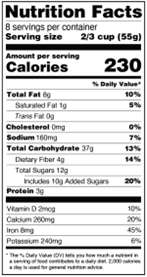
Example of US nutrition facts label
2. If certain nutrients are required to be displayed on the foreign nutrition facts label according to the requirements of that country but are not required to be displayed on the Thai nutrition facts label, the information on that nutrient does not need to be displayed on the Thai nutrition facts label.
For example, vitamin D is not a mandatory nutrient according to Notification No. 445, but the United States requires it to be displayed on the nutrition facts label. Therefore, the vitamin D content does not need to be displayed on the Thai nutrition facts label.
3. In the case of nutrients that are not required to be displayed on the nutrition facts label both in foreign and Thailand regulations but are nevertheless displayed on the nutrition facts label on a voluntary basis; the display of nutritional information on the Thai nutrition facts label must be consistent with the foreign nutrition facts label.
For example, vitamin C is not a mandatory nutrient according to Notification No. 445 and the EU regulations. However, if it is voluntarily displayed on the EU nutrition facts label, the Vitamin C content must also be displayed on the Thai nutrition facts label.
4. Food labels should provide a channel for consumer contact, such as a customer service center.
5. Advertisements of food that display a foreign language nutrition facts label must display the text: “Please see the nutritional information as displayed in the Thai nutrition facts label, because the requirements of Thailand and other countries may differ”; or other text with similar meaning.
Examples of accepted nutrition facts labels of other countries:
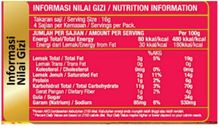
Shared Nutrition Facts Label (Indonesia – Philippines)
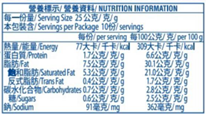
Hongkong
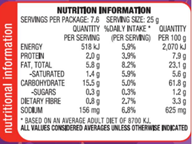
Australia

Shared Nutrition Facts Label (Philippines – Malaysia – Singapore – Hongkong)


Contact Details
101 True Digital Park, Griffin Building, Level 12A, Unit No.12A-06, Sukhumvit Road, Bangchak, Phra Khanong, Bangkok 10260
Tel: +66 (0) 2119-3350
membership@amchamthailand.com

